Immerse yourself in the vibrant tapestry of Namibia's cultural heritage on this 12-day self-drive journey through the heart of the country. This cultural experience delves into the traditions and...
Self-Drive
12 day journey
Duration
12 days
Group size
2–5 travellers
Style
Self-Drive
From
NAD 32,500 / pp
Departures
Year-round
Nights
11 nights away
The journey
Explore at your own pace.
Immerse yourself in the vibrant tapestry of Namibia's cultural heritage on this 12-day self-drive journey through the heart of the country. This cultural experience delves into the traditions and...
Immerse yourself in the vibrant tapestry of Namibia's cultural heritage on this 12-day self-drive journey through the heart of the country. This cultural experience delves into the traditions and customs of Namibia's diverse ethnic groups, offering a unique opportunity to connect with local communities and gain a deeper understanding of their way of life. From the Ju/'hoansi San Bushmen of Tsumkwe — one of humanity's oldest continuous cultures — to the ochre-adorned Himba pastoralists of Kaokoland, the Owambo farming communities of the north, and the Damara people of the central highlands, this journey reveals the extraordinary human richness that makes Namibia far more than a destination for landscapes alone.
Connect intimately with Himba pastoralists in the remote Kunene Region.
N° 02
Witness ancient rock art and San Bushmen heritage at Twyfelfontein.
N° 03
Experience the vibrant farming traditions of the Owambo communities.
N° 04
Explore the unique biodiversity and plateau landscapes of Waterberg Plateau Park.
N° 05
Engage with the cultural tapestry of the Damara people in the central highlands.
The route, drawn out.
6 stops 2,120 km total
NAMIBIA · CULTURAL EESRI
Loading map…
Itinerary
6 stops
1
Windhoek
Best: Year-round
2
Kaokoland
Day by day.
Times are flexible — we'd rather you stop for a long lunch than rush to the next viewpoint.
01
Day 1 · D
Windhoek – Arrival & City Introduction
Arrive at Hosea Kutako International Airport, collect your rental vehicle (an automatic 4×4 or comfortable SUV with all camping and navigation equipment), and transfer to your centrally located guesthouse in Windhoek. Spend the afternoon exploring the capital's walkable historic centre at your own pace. Begin at the Christuskirche — the neo-Gothic Evangelical Lutheran church (1910) that has become the icon of Windhoek — then walk up Robert Mugabe Avenue to the Alte Feste (Old Fort, 1890), which houses the National Museum of Namibia with its remarkable display on the Herero-Nama War (1904–08). Stroll through the Post Street Mall toward the imposing Independence Memorial Museum, whose exterior frieze depicts the faces of Namibia's liberation heroes. As evening falls, visit the Namibian Craft Centre on Tal Street — the best one-stop shop for quality traditional crafts: San beadwork, Himba dolls, Kavango woodcarvings, and Herero fabric dolls. Dinner at a recommended local restaurant introduces you to Namibian cuisine — sample oryx carpaccio, mopane worm fritters, or the iconic kapana street beef.
Windhoek
Overnight—
Meals
What's included.
From NAD 32,500 per person
Included
12 nights' luxury accommodation in handpicked lodges and guesthouses.
Daily breakfast, 5 lunches, and 7 dinners as specified in your detailed itinerary.
Fully equipped 4x4 rental vehicle with unlimited mileage and premium insurance.
Comprehensive pre-departure briefing and personalised tour information pack.
All national park entrance fees and conservancy fees as per the itinerary.
Curated cultural experiences, including guided Himba village visit and San Bushmen interaction.
24/7 Kenakare Trip Advisors emergency support throughout your journey.
Detailed route maps and a GPS-enabled tablet with pre-loaded points of interest.
Cancellation policy+
Free cancellation up to 60 days before departure. 50% charge for cancellations made 30–59 days before departure. No refund for cancellations within 30 days of departure. All cancellations must be submitted in writing to reservations@kenakare.com.
Frequently asked questions.
What type of vehicle is provided for this self-drive tour?
+
You will be provided with a robust, fully-equipped 4x4 rental vehicle, ideal for navigating Namibia's diverse terrains. Our vehicles come with unlimited mileage and comprehensive insurance for your peace of mind.
Is it safe to self-drive in Namibia, especially through remote areas?
+
Yes, self-driving in Namibia is generally very safe, and Kenakare Trip Advisors provides meticulously planned routes, detailed maps, and 24/7 emergency support. We ensure you are well-prepared for your adventure, even in more remote regions like Kaokoland.
What should I know about cultural etiquette when visiting local communities?
+
We encourage respectful and genuine interaction. Your Kenakare itinerary will provide specific guidelines, but generally, it's best to dress modestly, ask permission before taking photographs, and engage with an open mind. Our local guides will help facilitate meaningful exchanges.
Enjoy the freedom of a meticulously planned luxury self-drive adventure across Namibia.
N° 07
Gain profound insights into Namibia's diverse ethnic groups and their way of life.
Best: May to October
3
Twyfelfontein
Best: May to October
4
Waterberg Plateau Park
Best: May to October
5
Ovamboland
Best: May to September
6
Kunene Region
Best: May to October
Total drive2,120 km
Dinner
02
Day 2 · B
Windhoek – Deep Dive into the Capital's Cultural Mosaic
A full day exploring the multi-ethnic layers of Windhoek — a city where German colonial architecture stands beside Herero-owned businesses, Nama craft stalls, and a vibrant Black African majority culture forged through independence. Morning: join a guided walking tour of the historic quarter — Rider Memorial (honouring German colonial soldiers, now a point of contested heritage), Parliament Gardens, the Turnhalle (site of the 1975 constitutional conference), and the landmark Christuskirche. Mid-morning: drive to Katutura township — literally meaning 'the place where we do not want to live' in Herero, a name that reflects its origins as a forced-removal settlement during apartheid but is now a vibrant, proudly self-sufficient community of 100,000+ residents. Visit the Penduka women's crafts cooperative (famous for embroidered fabrics and beadwork), the legendary open-air Katutura barbecue strip (kapana), and the lively Single Quarters market where you can find everything from fresh mopane caterpillars to imported East African fabrics. Afternoon: visit the Independence Memorial Museum for an absorbing overview of Namibia's 25-year liberation struggle, followed by the Owela Display Centre with its natural history and ethnological collections. Evening at leisure — try Joe's Beerhouse, an Namibian institution famous for its game meat menu and bush atmosphere.
Windhoek
Overnight—
MealsBreakfast
03
Day 3 · B
Windhoek to Grootfontein – World's Largest Meteorite (470 km)
Depart Windhoek northbound on the B1 as the city gives way to the rolling hills of the Khomas Hochland. Stop in Okahandja (60 km north) — the cultural heartland of the Herero people and home to the Okahandja woodcarvers' market, a sprawling outdoor sculpture gallery where local craftsmen sell giraffes, hippos, and abstract busts carved from leadwood and camelthorn. Continue north through the Otavi Triangle — Namibia's most fertile farming region, watered by an underground lake — through the historic copper-mining town of Tsumeb, and arrive in Grootfontein by early afternoon. The town's main attraction is the extraordinary Hoba Meteorite Site, just 20 km west of town. The Hoba meteorite is the world's largest known intact meteorite: a 60-tonne iron-nickel mass measuring 2.7 × 2.7 × 0.9 metres, estimated to have fallen to Earth approximately 80,000 years ago during the Pleistocene. It was discovered in 1920 by a farmer ploughing his field — he heard a metallic clang and dug down to find this extraordinary object. A National Monument and open-air museum has been built around it. Walk around the meteorite, read the interpretive boards, and marvel at the fact that this single object is heavier than any aircraft you've ever flown in. Return to Grootfontein for dinner at a local guesthouse or restaurant, exploring the town's attractive German colonial architecture and shaded avenues.
Windhoek
Overnight—
Drive470 km
MealsBreakfast
04
Day 4 · B/D
Grootfontein to Tsumkwe – Gateway to Bushmanland (~190 km)
Turn east on the gravel C44 road into one of Namibia's most remote and pristine landscapes — the Bushmanland plateau of the Otjozondjupa Region. The road passes through deep Kalahari thornbush as settlements thin and eventually disappear; the landscape belongs entirely to wildlife and the San people who have lived here for at least 70,000 years. Arrive at Tsumkwe — the only settlement in a region the size of Switzerland — a small service village with a fuel station, a few shops, and a community campsite. This afternoon, meet your community liaison from the local Ju/'hoansi San community, who will introduce you to the village and arrange tomorrow's cultural programme. In the late afternoon, take a gentle village walk to begin understanding Ju/'hoansi life: observe the semi-permanent huts (domed frames of bent branches thatched with dried grass), watch the women at work preparing food and crafting intricate ostrich-eggshell bead jewellery, and learn about the egalitarian social structure of this ancient community — one where leadership is earned not inherited, and sharing is a moral obligation. Evening: storytelling session around a fire, with your guide translating the community's oral history.
Overnight—
Drive190 km
MealsBreakfast, Dinner
05
Day 5 · B/D
Tsumkwe – Full Day Ju/'hoansi San Cultural Immersion
Today is genuinely life-changing. Spend a full day with Ju/'hoansi San trackers and community members in the surrounding bush. Morning bush walk (3–4 hours): move through the thornbush with experienced trackers who read the landscape like a library. Learn to identify animal spoor — lion pad, porcupine quill, honey badger dig — and to follow tracks across different soils. Discover edible and medicinal plants: the tsamma melon (natural water source), the /xaro root (fever treatment), and the marula tree (food and alcohol source). Watch a masterclass in traditional bow-and-arrow construction — the slender bows strung with gemsbok sinew, the arrows tipped with carefully measured doses of plant-derived poison. Witness fire-making by friction: two sticks, dried grass tinder, and the focused energy of a San elder can produce a flame in under two minutes. Midday: sit with the women as they prepare a communal meal from gathered ingredients — fresh fruit, tubers, and whatever the hunters have brought in. Afternoon: the climax of this extraordinary day — a n/om-kxao trance healing dance performed by the community. This is one of humanity's oldest continuous spiritual traditions, practiced continuously for over 70,000 years. The healers enter an altered state of consciousness through rhythmic music, hyperventilation, and total physical surrender, channelling what the San call n/om (spiritual energy) to heal community members and connect with the spirit world. Witnessing this sacred ceremony with respectful curiosity and an open mind is among the most profound experiences Africa can offer. Return to camp for an evening debrief and dinner under a sky so dark that the Milky Way casts visible shadows.
Overnight—
MealsBreakfast, Dinner
06
Day 6 · B
Tsumkwe to Ondangwa – Into Ovamboland (~350 km)
Depart Tsumkwe westward on the C44, re-join the B8, and head north through the flat Kavango-East Region into Ovamboland — the heartland of the Owambo people, Namibia's largest ethnic group comprising approximately 50% of the national population. The landscape transitions from Kalahari thornbush to the vast oshana (shallow floodplain) system of the Cuvelai basin — a unique hydrological network of shallow channels that fills with water during the rainy season, transforming the flat landscape into an inland delta. Arrive in Ondangwa by early afternoon. This afternoon, visit the SWAPO Historical Museum, which documents Namibia's liberation struggle — a story deeply rooted in the Owambo heartland, where the South West Africa People's Organisation was founded and where the liberation war was most fiercely fought. The exhibits are honest, moving, and essential for understanding modern Namibia. Walk the compact centre of Ondangwa, stopping at the colourful open-air market where vendors sell everything from dried Oshikundu millet beer to secondhand clothes imported from South Africa. Evening at a local guesthouse.
Overnight—
Drive350 km
MealsBreakfast
07
Day 7 · B/D
Ondangwa – Full Day Owambo Cultural Immersion
A rich and rewarding full day exploring the traditions of the Owambo people — Namibia's most politically influential and numerically dominant ethnic group. Morning: visit the Uukwaluudhi Royal Homestead, a living museum complex set within a traditional oshana environment. The site features authentic reconstructed royal compounds (omukunda) surrounded by wooden palisade fences — the architecture of social hierarchy made visible. Community members demonstrate traditional crafts: the weaving of palm-leaf baskets (used for grain storage, beer-straining, and as trade items), iron smelting using traditional bellows, and the production of traditional Owambo pottery decorated with geometric patterns. Midday: a visit to the sprawling Okatana open-air market — one of Namibia's most vibrant and authentic trading centres. Rows of vendors offer oshikundu (traditional sorghum beer served in calabash gourds), omakunde (cowpea leaves), oshifima pap, dried mopane caterpillars, handmade farm tools, and colourful Owambo fabrics. Afternoon: an immersive cooking class with local women preparing a traditional Owambo feast: oshifima (stiff millet/maize pap — the daily staple), omalyata (wild spinach stew with groundnuts), smoked kapana beef, and fresh butternut pumpkin from the homestead garden. Evening: a traditional Owambo cultural dance performance — the efundula (female initiation dance) and the ohangwena warriors' dance — performed with full regalia of copper jewellery, oshithingo neck rings, and traditional dress.
Overnight—
MealsBreakfast, Dinner
08
Day 8 · B
Ondangwa to Opuwo – Crossing into Kaokoland (~300 km)
Drive west through the flat Ovamboland plains, passing through the border town of Oshakati and turning southwest toward the escarpment. As you head south and west, the flat oshana landscape gives way to the rugged Kaokoveld — one of the most remote and spectacular wilderness frontiers in Africa. The road (partly gravel) climbs dramatically through the Baynes Mountains before descending into the vast Kunene hinterland. Watch for desert-adapted elephant and giraffe crossing the road — this corridor is one of the last refuges for these long-ranging populations. Arrive in Opuwo by late afternoon — the administrative 'capital' of the Kunene Region and arguably the most fascinating small town in Namibia. Opuwo is a place of astonishing cultural contrasts: Himba women in traditional ochre-covered dress and copper jewellery browse the same Pick n Pay and Spar supermarkets as young Namibian professionals in Levi's jeans and Air Jordans. Young Himba men charge their smartphones at the service station while elders negotiate cattle prices in the street. Spend the late afternoon wandering the streets, observing this extraordinary meeting of ancient and modern. Arrange your guided Himba village visit for tomorrow through your guesthouse — always use a community-endorsed local guide to ensure respectful, ethical access.
Kaokoland
Overnight—
Drive300 km
MealsBreakfast
09
Day 9 · B
Opuwo – Full Day Himba Village Experience
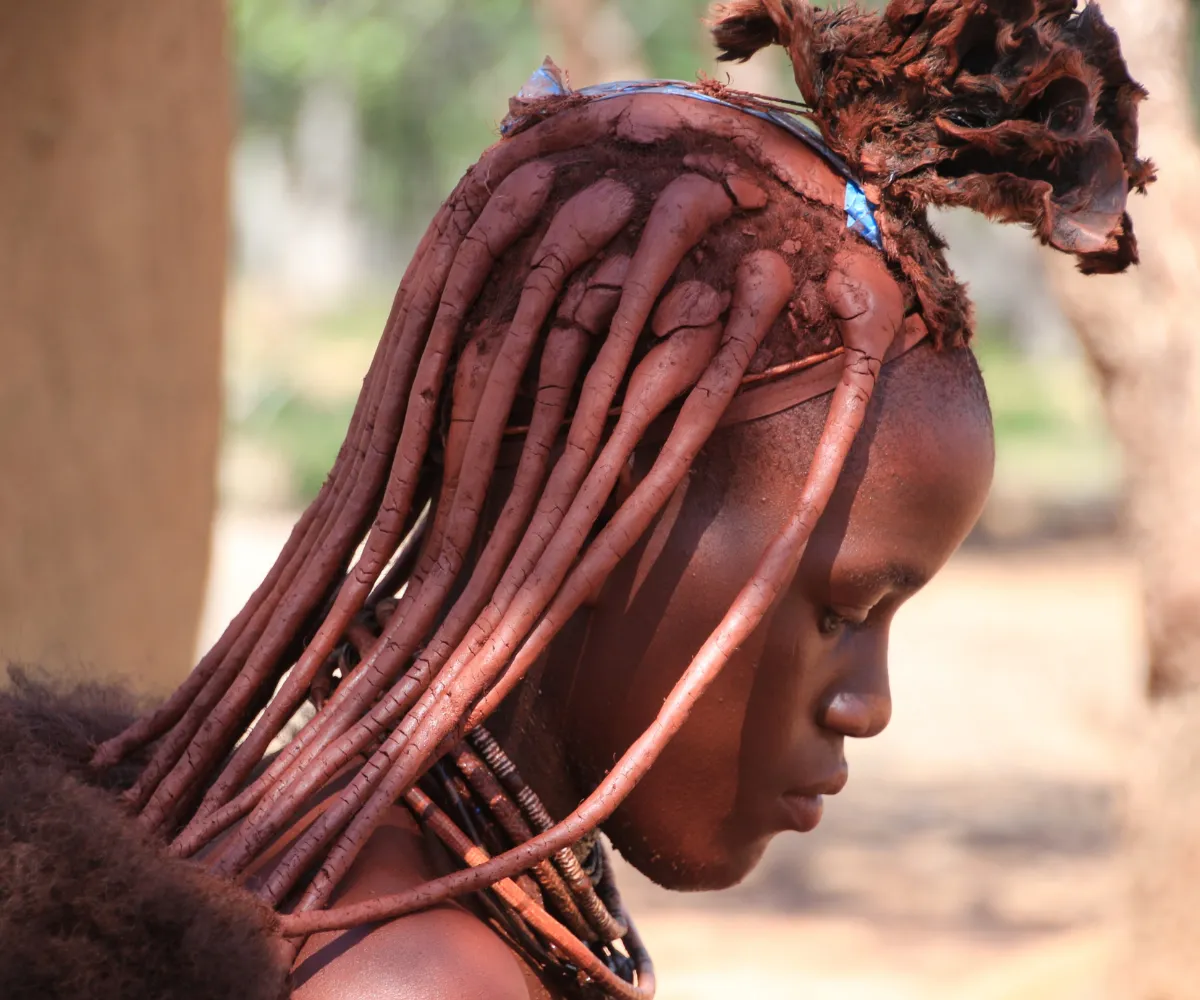
The Himba are one of Africa's last truly traditional semi-nomadic peoples — a community of approximately 50,000 pastoralists who have maintained their cultural practices largely unchanged despite Namibia's independence and modernity pressing in on all sides. Today's visit, conducted by a community-endorsed local Himba guide who speaks OtjiHimba and English, provides a genuine and deeply respectful window into a way of life the rest of the world has all but forgotten. Drive 20–40 km from Opuwo into the hills to visit one or two traditional homesteads (onganda). Morning ritual observation: watch and participate in the extraordinary otjize ceremony — the preparation and application of a rich blend of butterfat, ochre (red iron oxide), and aromatic omuzumba shrub resin. Applied daily to skin, hair, and clothing, otjize serves simultaneously as sunscreen, moisturiser, insect repellent, and profound cultural identity marker. The deep red-orange glow of the mixture on skin and hair — one of the most visually striking cultural practices in the world — is far more than aesthetics; it represents a woman's connection to the earth, to the cattle-keeping way of life, and to her ancestors. Your guide explains the matrilineal clan system (oruzo), the sacred ancestral fire (okuruwo) that burns continuously in every homestead, and the complex social rules governing food taboos, marriage, and property rights. Watch the women crafting traditional jewellery: copper wire beaten into arm cuffs, iron bracelets hammered to shape, and intricate leather-and-metal headpieces that denote marital status and clan affiliation. Engage in open conversation (via your guide) about the challenges and choices of cultural preservation: many younger Himba are choosing to engage with formal education, move to towns, and adopt modern dress, while others are committed to maintaining the traditional pastoral life. Return to Opuwo in the late afternoon for a quiet evening of reflection.
Kaokoland
Overnight—
MealsBreakfast
10
Day 10 · B
Opuwo to Khorixas – Damara Living Museum (~230 km)
Drive south from Kaokoland into the heart of Damaraland — homeland of the Damara people, one of Namibia's oldest and most intriguing ethnic groups. The Damara speak a Khoekhoegowab click language linguistically similar to the Nama and San languages, yet genetic and historical evidence suggests they were not originally a Khoisan people — their origins remain one of southern Africa's greatest anthropological mysteries. The landscape transitions from the steep Kaokoveld escarpment to Damaraland's characteristic open rocky plains dotted with ancient mopane trees and towering euphorbia candelabrum. Stop at Twyfelfontein (a UNESCO World Heritage Site) en route: 6,000 individual rock engravings — including lions with geometric patterns and dancing human figures — carved into the sandstone by San hunter-gatherers over the last 6,000 years. A UNESCO guide leads a 45-minute walk through the site. Continue to the Damara Living Museum near Khorixas — a remarkable community-owned cultural centre where Damara community members demonstrate traditional practices in an authentic outdoor setting: traditional food preparation (roasting mopane caterpillars, preparing //nara melon), fire-making with friction sticks, bow-and-arrow archery, traditional music on the !goin!goin mouth bow, and the ancient practice of making jewellery from copper and ostrich eggshell. Importantly, all proceeds from the museum go directly back into the community's education and development fund. Arrive in Khorixas for the evening.
Twyfelfontein
Overnight—
Drive230 km
MealsBreakfast
11
Day 11 · B
Khorixas to Waterberg Plateau – Ancient Rock & Living Wildlife (~330 km)
Morning exploration of additional Damaraland heritage sites. The Petrified Forest (35 km west of Khorixas) contains the ancient trunks of 260-million-year-old Glossopteris trees transported from distant Gondwana forests by a catastrophic flood and preserved in silicified sand. These logs — some 30–40 metres long and completely turned to stone — lie scattered across the gravel plain like a giant's woodpile. A Damara guide leads the 45-minute interpretive walk. Ten kilometres further, the extraordinary Organ Pipes: a narrow gorge filled with parallel columns of ancient dolerite, each column 4–5 metres tall and perfectly hexagonal — formed when molten magma cooled 120 million years ago and contracted into geometric crystalline forms. Drive east and then south through the Namibian thornbush on improving roads toward the Waterberg Plateau — a dramatic flat-topped sandstone mesa rising 200 metres above the surrounding Kalahari plains. Arrive by late afternoon and take a short introductory walk along the escarpment base as the plateau walls turn vivid red in the setting sun. The Waterberg is one of Namibia's most important protected breeding sanctuaries, established to protect and grow populations of sable antelope, roan antelope, white rhino, buffalo, tsessebe, and eland — species that were critically depleted during the colonial period.
Overnight—
Drive330 km
MealsBreakfast
12
Day 12 · B
Waterberg Plateau to Windhoek – Sunrise Hike & Farewell (250 km)
Rise early for a guided sunrise hike along the Waterberg Plateau's southern rim — one of the finest wildlife walks in Namibia. The plateau top supports a completely different ecosystem from the plains below: fig forests, sandstone kopjes, and pan habitats visited by rhino, roan antelope, sable antelope, and a remarkable diversity of raptors including the rare Cape vulture and Verreaux's eagle. The 360-degree views from the rim — across the Kalahari thornveld stretching to the horizon in every direction — are among the finest panoramas in Namibia. Return to camp for breakfast and pack the vehicle. The final 250 km drive south to Windhoek on the B1 passes through farmland and the Khomas Hochland highlands. Arrive in Windhoek by early afternoon for airport connections or a final night in the capital. Your 12-day journey through the extraordinarily diverse human heritage of Namibia draws to a close. You depart not just with memories of landscapes and wildlife, but with a deeply enriched understanding of the communities — San, Himba, Owambo, Damara, Herero — whose ancient wisdom, artistry, and resilience make Namibia one of the most culturally significant destinations on Earth.
Windhoek
Overnight—
Drive250 km
MealsBreakfast
Not included
International and domestic flights to/from Namibia.
Comprehensive travel and medical insurance.
Fuel for the rental vehicle.
Gratuities for guides, lodge staff, and other service providers.
Visa fees (if applicable) and personal expenses.
Optional activities not specified in the itinerary.
What is the best time of year to undertake this Cultural Experience tour?
+
This tour can be enjoyed year-round, but the dry season (May to October) offers pleasant temperatures and excellent visibility for cultural activities and wildlife viewing. The wet season (November to April) brings lush landscapes and vibrant birdlife, though some roads might require more cautious driving.
What level of physical fitness is required for this tour?
+
This tour is rated as 'moderate' difficulty. While it's primarily a self-drive experience, it involves some walking during cultural village visits and exploring sites like Twyfelfontein. A basic level of fitness to navigate varied terrain comfortably is recommended.