Embark on an unforgettable 19-day self-drive journey through Namibia's most iconic geographical features and natural landmarks. This comprehensive tour takes you on a thorough exploration of the...
Self-Drive
19 day journey
Windhoek
Fish River Canyon
Duration
19 days
Group size
2–5 travellers
Style
Self-Drive
From
NAD 238,000 / pp
Departures
Year-round
Nights
18 nights away
The journey
Explore at your own pace.
Embark on an unforgettable 19-day self-drive journey through Namibia's most iconic geographical features and natural landmarks. This comprehensive tour takes you on a thorough exploration of the...
Embark on an unforgettable 19-day self-drive journey through Namibia's most iconic geographical features and natural landmarks. This comprehensive tour takes you on a thorough exploration of the country's extraordinary diversity: from the world's second-deepest canyon at Fish River in the far south, through the towering red dunes of Sossusvlei and the ghostly diamond-mining ruins of Lüderitz, along the Atlantic coast to adventure-loving Swakopmund, north to the ancient rock engravings of Twyfelfontein, then east to the wildlife spectacle of Etosha, and finally north through the fertile Otavi Triangle to the towering Waterberg Plateau. This is the grand tour — the complete Namibia in a single journey.
Kolmanskop ghost town — diamond rush ruins swallowed by dunes
N° 03
Sossusvlei & Deadvlei — towering red dunes and petrified trees
N° 04
Lüderitz — Namibia's most unique colonial coastal town
N° 05
Cape Cross seal colony — largest in the world
The route, drawn out.
7 stops 3,610 km total
NAMIBIA · NAMIBIAN LESRI
Loading map…
Itinerary
7 stops
1
Windhoek
Best: Year-round
2
Day by day.
Times are flexible — we'd rather you stop for a long lunch than rush to the next viewpoint.
01
Day 1 · D
Windhoek – Arrival & Capital Orientation
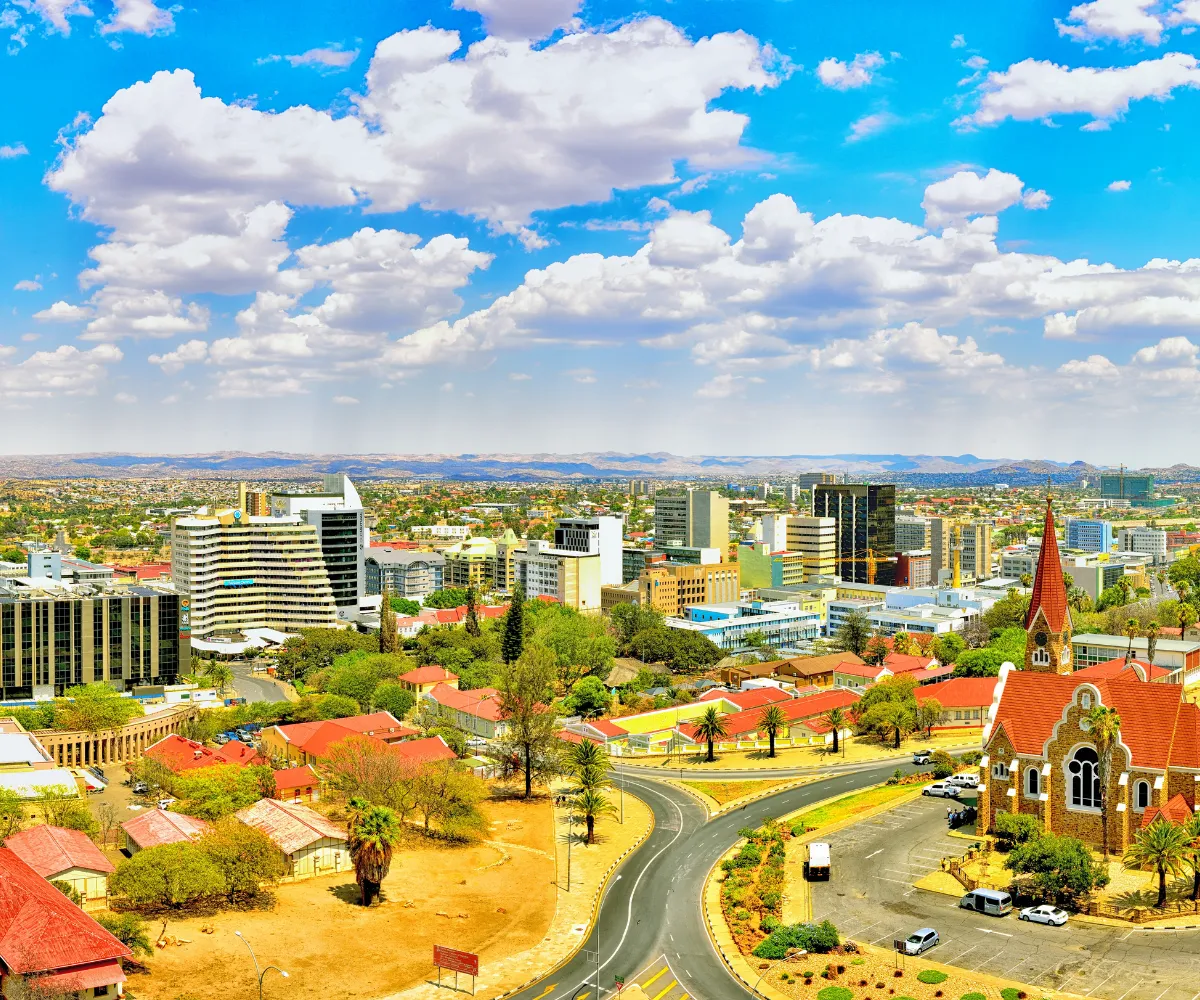
Collect your 4×4 rental vehicle at the airport — pre-loaded with detailed route notes, maps, and emergency contacts for every stop on this 19-day circuit. Transfer to your guesthouse in Klein Windhoek and spend the afternoon absorbing Windhoek's distinctive character: a capital of 350,000 people that somehow manages to feel like a large German spa town with an African heartbeat. Visit the Christuskirche, the Alte Feste, and the Independence Memorial Museum to establish the historical and cultural context for your journey. Evening: welcome dinner with a route overview briefing — the logistics of 19 days across 5,000+ km of Namibian roads demand a clear game plan.
Windhoek
Overnight—
MealsDinner
02
What's included.
From NAD 238,000 per person
Included
Accommodation
Car Rental
Airport Transfers
Meals as indicated
Meet and greet
2nd Driver
Unlimited mileage
Not included
Travel Insurance
Fuel
Personal expenses
Cancellation policy+
Free cancellation up to 60 days before departure. 50% charge for cancellations made 30–59 days before departure. No refund for cancellations within 30 days of departure. All cancellations must be submitted in writing to reservations@kenakare.com.
Twyfelfontein UNESCO rock engravings — 6,000 panels
N° 07
Etosha National Park — black rhino, lion, and elephant
N° 08
Waterberg Plateau — roan antelope, sable, and white rhino
N° 09
Hoba Meteorite — the world's largest known meteorite
Lüderitz
Best: Year-round
3
Sossusvlei and Deadvlei
Best: May to October
4
Swakopmund
Best: Year-round
5
Twyfelfontein
Best: May to October
6
Etosha National Park
Best: May to October
7
Fish River Canyon
Best: May to September
Total drive3,610 km
Day 2 · B
Windhoek – Full City Day
A full day to explore Windhoek properly before the long-distance driving begins. Morning: guided walking tour of the historic centre — Rider Memorial, Parliament Gardens, the Turnhalle, and the twin spires of the Christuskirche. Visit Katutura township for the lively open-air barbecue strip (kapana) and the Penduka women's craft cooperative. Afternoon: stock up on supplies for the journey south — the roads ahead are remote, fuel stops are sparse, and a well-provisioned vehicle is a safe vehicle. Visit the excellent Wecke & Voigts department store or the Pick n Pay on Independence Avenue for provisions. Evening: dinner at Joe's Beerhouse or the Gathemann Restaurant on Independence Avenue — Windhoek's most iconic dining institutions.
Windhoek
Overnight—
MealsBreakfast
03
Day 3 · B
Windhoek to Keetmanshoop – Quiver Tree Forest (~490 km)
Depart Windhoek south on the B1 — heading deeper into the Karoo landscapes of southern Namibia. The drive passes through Rehoboth (coffee stop), Mariental (fuel and lunch), and the vast flat Hardap plains before arriving in Keetmanshoop. Just 14 km east of town lies the extraordinary Quiver Tree Forest (Köcherbaumwald) — a National Monument featuring approximately 250 Aloe dichotoma trees growing on a rocky hillside, their thick silver-grey trunks branching into characteristic T-shapes against the cobalt sky. The San once hollowed out the soft, fibrous branches to make quivers for their arrows — hence the name. Nearby, the Giant's Playground: a spectacular jumble of dolerite boulders the size of houses, stacked in improbable equilibrium as if a giant child arranged them during play. Evening: Keetmanshoop guesthouse, with dinner in town.
Overnight—
Drive490 km
MealsBreakfast
04
Day 4 · B
Keetmanshoop to Lüderitz – Diamond Coast (~340 km)
Drive southwest on the B4 through increasingly barren landscape — the southern Namib is the most desolate section of Namibia's road network, a seemingly endless gravel plain broken only by the occasional isolated inselberg. Stop at Aus, the small desert town famous for its population of free-roaming feral horses — the descendants of German cavalry horses abandoned during World War I, now adapted to desert life over 100 years. A dedicated viewpoint with water troughs brings the horses close enough for excellent photography. Continue west as the Namib deepens and the road descends toward Lüderitz Bay — a genuinely astonishing moment when the cold Atlantic suddenly appears at the end of a 200-km desert traverse. Lüderitz is unlike anywhere else in Namibia: a perfectly preserved German colonial town of Art Nouveau and Wilhelmine architecture clinging to a rocky Atlantic peninsula, surrounded by guano islands, jackass penguin colonies, and the cold, fog-shrouded Benguela upwelling. Check in and walk the seafront in the bracing evening wind.
Lüderitz
Overnight—
Drive340 km
MealsBreakfast
05
Day 5 · B/D
Lüderitz – Kolmanskop Ghost Town & Bay Exploration
A full day to explore Lüderitz and its extraordinary environs. Morning: the unmissable Kolmanskop ghost town, 10 km east of Lüderitz. Kolmanskop was built as a purpose-made diamond mining town in 1908, complete with casino, theatre, bowling alley, ice factory, and hospital — extraordinary luxury for workers in the middle of the Namib. When the diamond deposits were exhausted in the 1930s, the town was abandoned in months, and the Namib has been reclaiming it ever since: rooms are knee-deep in drifted sand, ceilings have collapsed under the weight of dunes, and the swimming pool is half-buried. A licensed guide leads the 45-minute tour through the peeling, sand-filled rooms — one of the most atmospheric and surreal heritage sites in Africa. Afternoon: explore Lüderitz itself at a leisurely pace. Walk up to the Felsenkirche (1912) — the Art Nouveau Lutheran church on the hill — for panoramic views over the bay. Take a short boat cruise to Penguin Island to observe the African penguin colony at close range. Walk the waterfront past Goerke Haus (the most elaborate colonial mansion in Namibia, now restored as a museum) and along the main Bismarck Street with its remarkable array of intact Wilhelmine commercial buildings. Dinner at one of Lüderitz's seafood restaurants: the crayfish are exceptional.
Lüderitz
Overnight—
MealsBreakfast, Dinner
06
Day 6 · B/D
Lüderitz to Sesriem via the Southern Namib (~450 km)
A long but visually extraordinary drive north through the southern Namib — considered by many to be the most beautiful section of Namibia's road network. Depart Lüderitz east on the B4, returning through Aus and then turning north on the C13 — a remote gravel road through the heart of the southern Namib. The landscape is mineral and intense: cream and ochre gravel plains framed by mountains of red granite, with occasional dry riverbeds where desert-adapted trees cling to subsurface moisture. Stop at Helmeringhausen for fuel and a famous slice of cake at the old hotel — one of the great Namibian roadhouse traditions. Continue through the Tiras Mountains and the NamibRand Nature Reserve, where the dunes transition from the grey southern Namib to the deep rust-red of the Sossusvlei dune field. Arrive at Sesriem by early evening, in time for a dramatic desert sunset from a dune crest. Dinner at your desert camp or lodge under a sky of extraordinary stellar clarity.
Sossusvlei and Deadvlei
Overnight—
Drive450 km
MealsBreakfast, Dinner
07
Day 7 · B/D
Sossusvlei & Deadvlei – The Red Dune Sea
The day most Namibia visitors have been dreaming of. Pre-dawn departure to Dune 45 for the legendary Sossusvlei sunrise: climb the 170-metre ridgeline as the sky cycles from navy to crimson to gold. A 4×4 transfer takes you deeper into the dune field to the main Sossusvlei clay pan, then into the haunting Deadvlei — the white calcrete lake bed surrounded by dunes up to 325 metres high, its floor scattered with the 900-year-old mummified skeletons of camel thorn trees. Return to camp by noon and rest through the heat of the day — mandatory in the Namib, where temperatures regularly exceed 45°C in summer. Afternoon: walk the Sesriem Canyon with your route notes for geological context. The canyon walls reveal 40 million years of Namib history in alternating layers of pebble conglomerate and silicified sand. Evening star-gazing: Sesriem is located in one of the world's darkest sky zones, and on a moonless night the Milky Way casts visible shadows.
Sossusvlei and Deadvlei
Overnight—
MealsBreakfast, Dinner
08
Day 8 · B
Sesriem to Swakopmund – Solitaire & Moon Landscape (~350 km)
Depart Sesriem on the C26 north through the Namib-Naukluft's gravel plains. First stop: Solitaire — the iconic desert petrol station and bakery, a true Namibian institution. Moose McGregor's apple pie (baked fresh each morning) is mandatory; the fleet of rusting vintage cars in the yard makes for excellent photography. Continue north through the Tropic of Capricorn marker and across the vast central Namib plains, where the horizon in every direction is a perfectly flat line of gravel meeting sky. The B2 highway then climbs to the edge of the Namib's Parabola and descends through the spectacular Moon Landscape — ancient volcanic rock formations eroded by the Swakop River into a surreal grey-brown moonscape that has served as a stand-in for alien worlds in countless films. Stop at Goanikontes Oasis — a small, incongruously green farm in the Swakop River gorge — for cold drinks and a quick walk. Arrive in Swakopmund by early afternoon for check-in and a coastal stroll. Dinner: fresh crayfish or Walvis Bay oysters — mandatory after days of desert driving.
Swakopmund
Overnight—
Drive350 km
MealsBreakfast
09
Day 9 · B/D
Swakopmund – Full Day Activities
A full free day in Swakopmund to recover from desert driving and enjoy the Atlantic coast. Morning activity choice: the Living Desert tour (recommended for first-timers) reveals the extraordinary micro-fauna of the Namib — sidewinder snakes, palmato geckos, dancing white lady spiders, legless lizards, and tok tokkie beetles, found and handled by a specialist naturalist guide. Alternatively: a Walvis Bay flamingo catamaran cruise takes you through the extraordinary lagoon ecosystem where 50,000 flamingos and 2,000 Cape pelicans feed in the rich Benguela waters. Afternoon: walk Swakopmund's excellent high street — Bismarck Street and Sam Nujoma Drive — browsing the jewellery shops (Namibian blue diamonds, tourmaline, and malachite), the excellent BookStall, and the Swakopmund Museum with its remarkable collection of Namibian natural history. Sundowners on the beachfront promenade as the famous Swakopmund sea-fog rolls in from the Benguela current, reducing visibility to metres and dropping the temperature 10°C in minutes — a dramatic meteorological performance. Dinner at the Swakopmund Hotel's restaurant or the popular Jetty 1905 seafood bar.
Swakopmund
Overnight—
MealsBreakfast, Dinner
10
Day 10 · B/D
Cape Cross Seal Colony & Back to Swakopmund (~260 km return)
Day trip north along the Skeleton Coast to Cape Cross — one of the most extraordinary wildlife spectacles in the world. Drive 130 km north on the C34 along the Skeleton Coast highway, passing the salt works at Swakopmund and the guano platforms at Walvis Bay. Cape Cross Seal Reserve protects the world's largest single Cape fur seal colony, with between 80,000 and 100,000 seals hauled out on the rocky shore at any one time (and up to 200,000 during the November–December pupping season). The noise, the smell, and the sheer density of life here are almost overwhelming: adult bulls weighing up to 360 kg battle constantly for territory, females nurse pups the size of cats, and the beaches are alive with flippers, whiskers, and the constant barking that carries kilometres in the sea wind. Black-backed jackal patrol the seal colony edges looking for unguarded pups and afterbirth; brown hyena are occasionally sighted at dawn. Historical note: Cape Cross was where Diego Cão erected a stone cross in 1486, making it the southernmost point reached by early Portuguese explorers and the first European landing point in what is now Namibia. Return to Swakopmund for a late lunch and a final afternoon stroll before dinner.
Swakopmund
Overnight—
Drive260 km
MealsBreakfast, Dinner
11
Day 11 · B
Swakopmund to Twyfelfontein – Damaraland (~350 km)
Depart Swakopmund north on the C34 Skeleton Coast highway, passing through the salt pans at Henties Bay and the distinctive white-painted Messum Crater turnoff. Turn inland on the C39 toward the Brandberg massif — Namibia's highest mountain at 2,573 metres — a vast granite dome of extraordinary geological complexity that rises sheer from the surrounding plains. The Brandberg houses over 50,000 individual rock paintings in 879 shelters, including the famous White Lady of the Brandberg (c. 2000 BCE). A short guided hike into the Tsisab Gorge to see this extraordinary figure is highly recommended. Continue northeast through Khorixas and east to Twyfelfontein, arriving by late afternoon. Twyfelfontein — meaning 'doubtful spring' in Afrikaans — is one of Africa's most important archaeological sites, a Namibia UNESCO World Heritage Site containing over 6,000 individual rock engravings carved by San hunter-gatherers over 6,000 years, the largest known concentration of rock art in Africa. Check in to your camp in the Aba Huab valley and explore the immediate area before dinner.
Twyfelfontein
Overnight—
Drive350 km
MealsBreakfast
12
Day 12 · B/D
Twyfelfontein – Rock Art, Petrified Forest & Organ Pipes
A full day exploring the remarkable Damaraland heritage sites. Morning: UNESCO-guided tour of the Twyfelfontein rock engravings — 2–3 hours walking among the sandstone slabs, each panel a window into San spiritual life and ecological knowledge. The engravings depict lion with geometric patterns (maps of the spirit world?), giraffe the height of a man, human-animal transformation figures (therianthropes), and countless antelope and elephant. The sheer quantity and quality of the art here cannot be overstated: this is Namibia's most significant cultural site. Midday: drive 35 km west to the Petrified Forest — a scatter of ancient tree trunks from the Permian period (260 million years ago), transported by a catastrophic flood from distant Gondwana forests and silicified in place. These logs — some 30 metres long and completely mineralised — lie on the gravel plain like timber from another world, exactly where the floodwaters deposited them a quarter-billion years ago. Afternoon: the Organ Pipes (10 km from camp) — a narrow gorge exposing 120-million-year-old dolerite that cooled slowly and crystallised into perfectly hexagonal columns, stacked parallel like the pipes of an enormous organ. The geological violence of the formation process — magma forced between sedimentary layers under unimaginable pressure — is written in every shear plane and fracture. Return to camp for dinner as the desert air cools rapidly and the stars appear.
Twyfelfontein
Overnight—
MealsBreakfast, Dinner
13
Day 13 · B/D
Twyfelfontein to Etosha South (~300 km)
Depart Twyfelfontein east on the C39 and C35 through the heart of Damaraland — a landscape of magnificent desolation: flat gravel plains, isolated granite inselbergs, and vast distances. Stop at Kamanjab, the small service town at the northern edge of the Damaraland communal conservancy, for fuel and supplies before entering Etosha territory. Enter the park at the Galton Gate on the western side — far less used than the southern Anderson Gate and providing access to the most remote and productive section of the park. The western Etosha circuit sees far fewer visitors than the east, and the wildlife here — particularly lion, elephant, and cheetah — is correspondingly more relaxed and easier to approach. Drive to Okaukuejo camp through the western plains, stopping at every waterhole: Rietfontein, Sprokieswoud (the 'fairytale forest' of stunted mopane), and Salvadora. Arrive at Okaukuejo for the unmissable floodlit waterhole evening — your first night in Etosha on this grand tour.
Etosha National Park
Overnight—
Drive300 km
MealsBreakfast, Dinner
14
Day 14 · B/D
Etosha – Full Day Western Circuit
A full day dedicated to the western circuit — widely considered the best game-viewing section of Etosha. Dawn drive to Klein Okevi for black rhino, then west to Charitsaub, Kapupuhedi, and Moringa waterholes. The western woodland belt is the heartland of Etosha's lion population: the park holds approximately 300 lions, and the western circuit's combination of dense cover and productive waterholes makes this the most likely area for close encounters. Midday at the Okondeka floodplain — a vast open area where in the dry season enormous wildebeest and zebra herds congregate, with cheetah coursing across the open ground in spectacular high-speed pursuits. Afternoon along the saltpan edge, scanning the shimmering surface for flamingo, ostrich, and the mirages that transform distant animals into floating islands. Return to camp for the evening floodlit waterhole — night two, different cast of characters.
Etosha National Park
Overnight—
Drive150 km
MealsBreakfast, Dinner
15
Day 15 · B/D
Etosha – Full Day Eastern Circuit
Today crosses to the eastern section of the park — completely different in character from the west. The eastern circuit runs through open savanna grassland and acacia scrub, with the Etosha saltpan visible to the north as a white horizon. Drive through Halali — stopping at the dolomite waterhole complex — and east to Namutoni. The Namutoni area is famous for its enormous elephant herds: dry-season concentrations of 200+ elephant at a single waterhole are a regular occurrence at Klein Namutoni. Detour to Fischer's Pan if rains have been good — flocks of flamingo, pelican, and spoonbill transform this usually dry expanse into one of Etosha's finest birding spectacles. Afternoon: explore the tracks around Namutoni fort and the areas east of Halali — giraffe are abundant in the acacia woodland here, and the area supports the park's densest leopard population. Return to Okaukuejo for a final floodlit waterhole night.
Etosha National Park
Overnight—
Drive150 km
MealsBreakfast, Dinner
16
Day 16 · B
Etosha to Grootfontein – Hoba Meteorite (~280 km)
Final dawn drive before exiting via the Anderson Gate and heading east toward Tsumeb and Grootfontein. Tsumeb — the 'three-in-one town' (copper, lead, and zinc mining) — offers a notable stop at the Tsumeb Museum, which houses the extraordinary Tsumeb minerals collection: this single mine has produced over 247 different mineral species, including 83 found nowhere else on Earth — arguably the world's most mineralogically diverse locality. Continue to the Hoba Meteorite site outside Grootfontein — the world's largest known intact meteorite at 60 tonnes, a fitting geological bookend for a journey that began among 260-million-year-old Permian forests and 6,000-year-old rock art. Evening in Grootfontein at a comfortable guesthouse.
Overnight—
Drive280 km
MealsBreakfast
17
Day 17 · B
Grootfontein to Waterberg Plateau (~240 km)
Drive southwest from Grootfontein toward Otjiwarongo and then east on the B1 to the Waterberg Plateau. The journey passes through the Otavi Triangle's fertile farmlands and the Otjiwarongo highlands. Arrive at the Waterberg Plateau by early afternoon — the dramatic red sandstone mesa is visible from 30 km away, rising sheer from the surrounding Kalahari thornbush. Check in and spend the afternoon on a guided base-of-escarpment walk: your guide introduces the plateau's geology (Cretaceous sandstone deposited in an ancient river system) and its conservation significance — the last refuge in Namibia for sable, roan, and tsessebe antelope. Look up at the cliff faces for cliff-breeding Lappet-faced vultures, and keep eyes on the base woodland for the elusive leopard that regularly comes down at dusk.
Overnight—
Drive240 km
MealsBreakfast
18
Day 18 · B/D
Waterberg Plateau – Full Day Game Walks & Sundowner Hike
A full day to savour the Waterberg — the perfect decompression after 17 days of driving and game viewing. Morning: guided plateau rim walk (6–8 km, 3 hours) along the southern escarpment. The rim trail is the finest walking route in Namibia: 360-degree views across the Kalahari, excellent birding (Cape vulture, Verreaux's eagle, Brown snake eagle), and regular sightings of sable and roan antelope — species virtually impossible to see elsewhere in Namibia outside reserves. Your guide tracks fresh spoor across the sandstone and points out the micro-habitats of the plateau summit: sandveld grassland, seasonal pans, fig-tree forest in the kloofs. Midday rest at the lodge — pool, hammock, or birding from the deck. Late afternoon: a guided 90-minute sundowner hike to the highest accessible viewpoint on the plateau rim, arriving in time to watch the sun sink into the Kalahari as the thornbush turns gold and the cliff walls glow deep crimson. Toast the end of an extraordinary journey before the final descent to dinner.
Overnight—
MealsBreakfast, Dinner
19
Day 19 · B
Waterberg to Windhoek – Journey's End (~250 km)
A final breakfast at the foot of the Waterberg as the morning light turns the sandstone cliff warm orange. Load the vehicle for the last time and head south on the B1 toward Windhoek — a comfortable 250 km journey through familiar Namibian farmland. Stop in Okahandja for a final browse of the woodcarvers' market — the perfect last-minute gift-buying opportunity before the airport. Arrive in Windhoek by midday, return the rental vehicle, and reflect on 19 days that have covered virtually every aspect of this extraordinary country: the ancient desert canyons of the south, the diamond ghost towns of the Namib coast, the towering dune sea of Sossusvlei, the wild Atlantic shore, the ancient rock art galleries of Damaraland, the wildlife spectacle of Etosha, and the lush forested plateau of the Waterberg. You depart knowing that Namibia is not a destination but a transformation — a country that changes how you see space, silence, time, and the living world.